

From the Dock
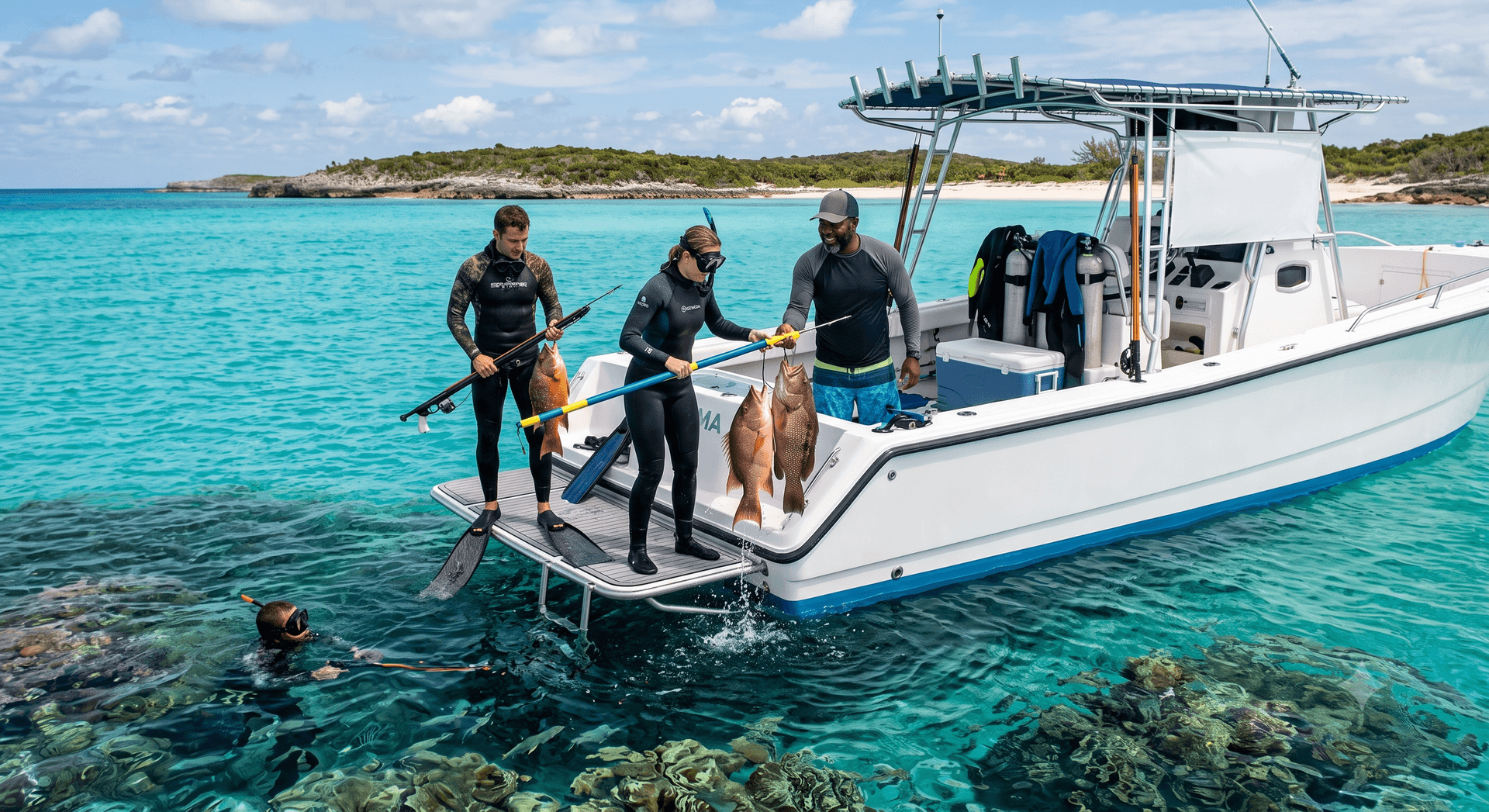
Three active captains are currently booking spearfishing charters in the Bahamas, with full-day trips dominating the region right now. Summer conditions have pushed target species—Nassau Grouper, Hogfish, Yellowtail Snapper, Mutton Snapper, and Lionfish—offshore and deep, so expect offshore and deep-drop operations to outperform traditional flats work through this season.
July in the Bahamas is not the easiest month to spearfish. Water temperatures are sitting above 86°F, which pushes some reef species deeper and thickens thermoclines. That said, it does not shut the fishery down. Grouper are still holding on structure in the 40–80 foot range. Hogfish are active on hard bottom in 15–40 feet and do not care what month it is. Lionfish — legal to spear year-round with no bag limit — are thick on every reef right now and most captains will welcome you targeting them. Summer also means calmer inter-island passages, longer daylight dive windows, and less boat traffic on the outer reefs. If you are ready to book a Bahamas spearfishing charter this month, you can find fish. You just need a captain who knows where the summer bite actually lives.
What Happens on the Day
Most Bahamas spearfishing charters run as private trips. You depart the marina between 7:00 and 8:00 AM. The captain runs you to reef or blue hole structure — typically 20 to 60 minutes offshore depending on the island — and anchors or drifts while you freedive. Depth on reef dives usually runs 15 to 50 feet, occasionally 60–80 feet on deeper ledges. A typical full-day trip includes 4 to 6 dive sites with surface intervals and a midday break. The captain or a mate handles the catch — cleaning, icing, and sometimes on-beach cooking if the operator offers it. Half-day trips cover 2 to 3 sites and are back at the dock by noon or 1:00 PM. Most operators in the Bahamas use pole spears and Hawaiian slings rather than pneumatic spearguns — know which your charter prefers before you show up. Some captains will accept your own equipment; confirm ahead of time.
The Regulations You Need to Know Before You Dive
This is the section most competitor guides skip, and it will save you a real problem on the water.
Nassau Grouper: Open season runs March 1 through November 30. Minimum size is 12 inches total length. The season is fully closed December 1 through February 28 — no exceptions. Nassau grouper is a protected species under Bahamas law, and enforcement is active. July puts you in open season, but size the fish before you shoot.
Spiny Lobster (Crawfish): Closed April 1 through July 31. You cannot take lobster right now. Season reopens August 1 — if your trip falls after that date, the limit is 6 per person per day with a 3.5-inch carapace minimum. No harvest of egg-bearing females. Foreign nationals cannot commercially harvest lobster; this is recreational only. Also important: no harvest by scuba diving is permitted under Bahamian law — lobster must be taken on breath-hold.
Queen Conch: 10 per person per day, year-round for sport fishing, with a minimum 3-inch lip thickness. Take only fully flared lip conch. Some island areas carry additional local protections — ask your captain before you take any.
Spearguns: Pneumatic and band-powered spearguns are legal for use in Bahamian waters by visitors, but possession of a speargun within one mile of a shoreline where fishing is prohibited can create legal problems. Stick to your captain's guidance on equipment. Pole spears and Hawaiian slings are universally accepted and preferred by most operators.
No scuba spearfishing: Bahamian regulations prohibit taking fish by spear while using scuba. All spearfishing must be done on breath-hold. This is a hard rule and captains take it seriously.
Best Islands for Spearfishing in the Bahamas
Andros Island is the strongest option for dedicated spearfishing. The Andros Barrier Reef — the third largest in the world — drops into the Tongue of the Ocean on its eastern edge, giving you reef structure, blue holes, and open-water opportunities within a short run. Grouper, hogfish, and snapper are all present. The interior blue holes hold species that rarely see divers. Captain access here is more limited than Nassau, which means less pressure on the reef.
Exuma Cays offer clear water and healthy reef populations in the 20–50 foot range. The Land and Sea Park (north Exumas) is a full no-take zone — no fishing, no spearing, no conch collection. Know exactly where you are. Outside the park boundaries, the reef fishing is productive and the water visibility in summer can exceed 80 feet on calm days.
Grand Bahama and the Abacos have accessible guide services, shallower reef structure, and shorter runs to productive water. Better for newer divers or those combining spearfishing with reef snorkeling. The outer reefs in the Abacos have taken hurricane damage over the years, but grouper habitat remains on hard bottom structure.
New Providence (Nassau) has the most operators but also the most pressure. Reef fish inside the regular dive circuit areas are educated. A good Nassau captain takes you away from the tourist dive sites — that is the differentiator when booking here.
Gear: What to Bring, What the Charter Provides
Most Bahamas spearfishing operators provide masks, snorkels, fins, weight belts, and basic pole spears or Hawaiian slings for rental. Do not assume quality. If spearfishing is the primary reason you are on this trip, bring your own setup.
Speargun: A 90–110cm band-powered gun handles most Bahamian reef work. Riffe and Rob Allen are the workhorses. For tighter structure like blue holes or cave overhangs, drop to a 75cm. Leave the 130cm at home unless you are doing pelagic blue water work.
Fins: Long-blade freediving fins make a material difference on deeper dives. Cressi Gara Modular or Omer Stingray are reliable mid-range options. Full-foot over open-heel for freediving.
Wetsuit: In July, 3mm is sufficient — water temperature above 86°F means heat is not your enemy, but a wetsuit still protects against stinging invertebrates and improves buoyancy control. In winter, step up to 5mm.
Float line and SMB: Required by any responsible operator and increasingly by Bahamian maritime practice. Your float line should be at least 30 feet. Carry a surface marker buoy you can deploy underwater.
Dive knife: Non-negotiable. Cressi Borg or similar fixed-blade. This is safety equipment, not decoration.
Lionfish gear: If your captain is targeting lionfish, bring or request puncture-resistant gloves. Some operators carry Zookeeper containment tubes — ask ahead.
Choosing the Right Charter: Pricing and What to Ask
Bahamas charter day rates currently run $250 to $1,500 per day, with the platform average sitting around $790. For spearfishing specifically, expect the mid-to-upper range for a private full-day trip — a legitimate spearfishing charter is not the same as a half-day reef snorkel. The captain is putting you on specific structure, managing dive safety, handling your catch, and navigating regulations actively.
Here is what separates a good spearfishing captain from a general charter that tolerates spearfishing:
- They can name specific reefs, blue holes, or ledges by location — not just "the reef"
- They have a current understanding of Nassau grouper and lobster season status and will brief you on it before you enter the water
- They dive themselves or have a mate in the water with you
- They carry a proper first aid kit and oxygen unit (ask directly)
- They use a float line system and have an SMB available
For beginners: most Bahamian spearfishing captains work with first-timers, but be honest about your freediving experience. A captain who puts a nervous breath-hold diver on a 60-foot reef edge is not doing you a favor. Ask what depth you will be targeting and whether shallow-water beginner sites are available.
Ask these questions before you book:
- Do you provide spearguns or do I need to bring my own?
- What species are realistically in season and in range right now?
- Do you or your mate enter the water with guests?
- What is your emergency oxygen protocol?
- What do you do with the catch — do you clean and ice it, and can I take it with me?
July Conditions: What to Realistically Expect Right Now
Water above 86°F and we are in hurricane season — those two facts shape your trip planning in July 2026.
Visibility: Summer brings plankton blooms in some areas that reduce visibility versus winter months. On calm days in the Exumas or on the Andros barrier reef's outer face, you can still get 60–80 feet of visibility. Inside reef sections and after weather, it drops. Ask your captain what visibility looked like on their last dive before you commit to a trip focused on long-range shots.
Weather windows: Operators here monitor the National Hurricane Center actively. Any charter will reschedule around named storms or tropical disturbances without penalty — build flexibility into your travel. Morning departures are the move in July; afternoon thunderstorms are reliable and build fast.
Species availability right now: Nassau grouper are in open season and holding on structure in the 40–80 foot range. Hogfish are accessible in shallower water. Yellowtail snapper are around reef edges on a chum drop. Lobster is closed until August 1 — do not target crawfish on a July trip. Lionfish are in season year-round and actively targeted by most conservation-minded operators.
Current lunar phase: We are in a waning crescent (21% illumination) right now. Less moonlight means reef fish are not feeding hard at night and will be more active and less skittish during daytime dives. That works in your favor for sight-hunting — fish on the reef are oriented to daytime feeding and less likely to spook deep before you can close distance.