

From the Dock
Summer conditions are pushing the best action offshore and to deep-drop territory this season. Flats species like permit, bonefish, and tarpon remain available, but mutton snapper, grouper, king mackerel, and barracuda are where the catamaran charters are connecting right now—hot water means deeper presentations outperform shallow work through September.
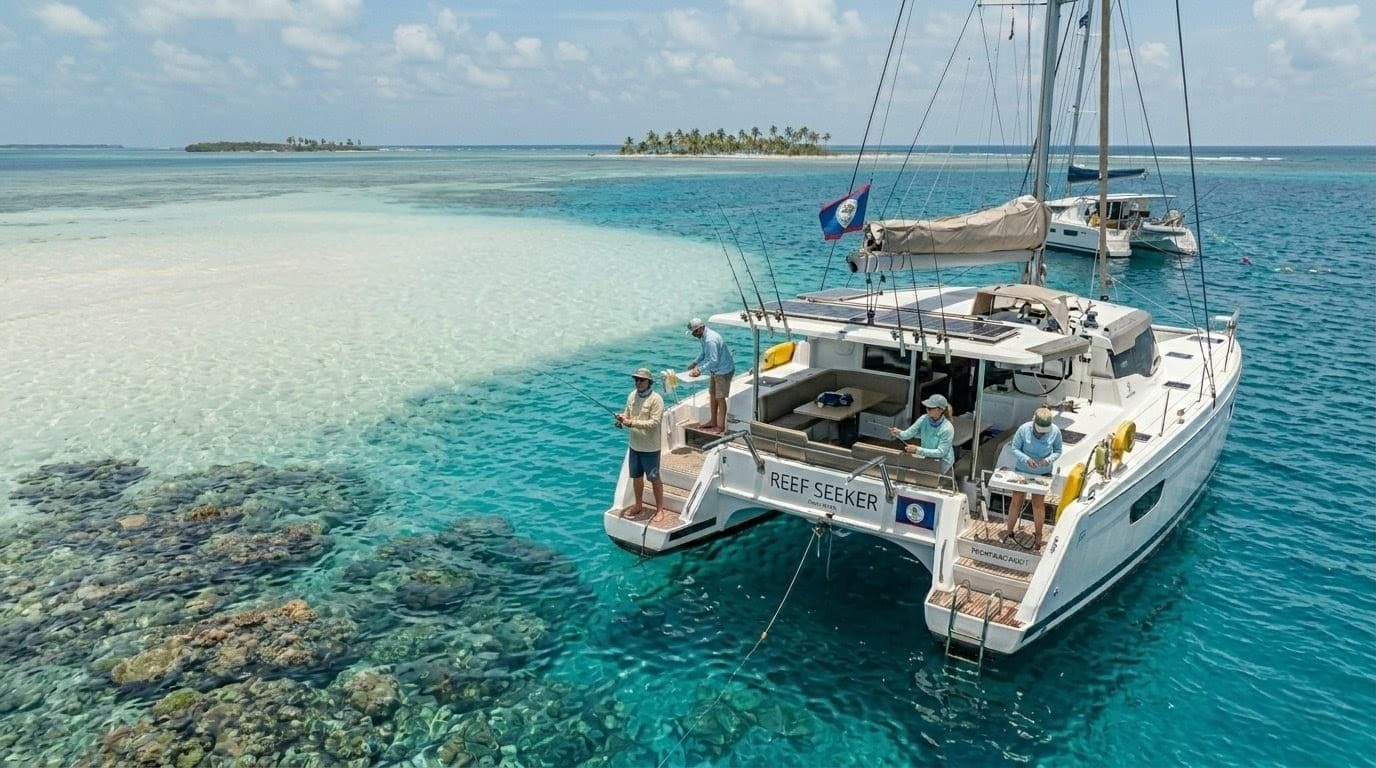
A catamaran charter in Belize is a practical fishing platform, not just a sailing trip. The dual-hull layout gives you stable anchor points for fly casting, flat deck space for fighting fish, and enough range under sail and motor to reach all three offshore atolls — Turneffe, Lighthouse Reef, and Glover's Reef — without flying to a separate lodge. You sleep aboard, reposition overnight, and fish different structure every morning. That's the case for booking a liveaboard cat over a day-boat fishing charter or a resort-based guide. This guide focuses on how to set up that trip around fishing objectives, including what September conditions actually look like right now.
September Conditions: What You're Working With
September sits deep in Belize's rainy season. That doesn't mean the fishing shuts down — it means you plan around weather windows instead of ignoring them. Offshore runs to Lighthouse Reef and Glover's Reef require a calm morning departure. The wind typically lays down by midday, but afternoon squalls build fast from the west. A crewed cat captain will monitor conditions daily and adjust the itinerary. Confirm that flexibility is explicitly part of your charter agreement before you book.
The barrier reef and Turneffe Atoll are more sheltered and consistently fishable in September. Mutton snapper, grouper, and barracuda hold on reef structure year-round. Permit are accessible on Turneffe's calm-day flats. Snook are in closed season under Belize Fisheries Regulations through September 30 — no harvest, no exceptions. Tarpon are catch-and-release only under Belizean law regardless of season.
The waning gibbous moon phase running through late September 2026 is a legitimate positive for permit. Post-full transition decreases overnight illumination, which pushes fish back to daytime feeding windows. Combine that with an incoming morning tide and you have a workable permit setup — even in rainy season. Check sea state the night before any planned atoll run.
Crewed vs. Bareboat: Which One Makes Sense
A bareboat catamaran in Belize requires a valid offshore sailing certification, familiarity with pass navigation through the reef, and serious comfort with provisioning and weather routing. The barrier reef has over 200 documented hazards. If you're asking whether you should go bareboat, the answer is probably no — not in Belize, not without prior reef sailing experience in the region.
A crewed charter costs more per day but gives you a captain who knows the cuts, a first mate who rigs tackle and handles the anchor while you cast, and operational flexibility to reposition without losing half the fishing day to boat handling. For a fishing-focused trip, the math is straightforward: the crew finds fish, you fish. Most crewed cats running 7–10 night itineraries in Belize carry two to four guests at capacity.
Day rate ranges vary. Entry-level crewed cats running 40–44 ft vessels with basic provisioning run roughly $1,200–$1,800 USD per day all-in for two anglers. Premium operators with dedicated fishing guides aboard, quality fly tackle, and full provisioning run higher. Fishing licenses are required for all guests — confirm whether your operator includes them or whether you purchase separately before arrival.
The Atoll Triangle: Where You're Going and Why
Belize's three atolls sit 20–50 miles offshore from the barrier reef. They are not day-trip destinations in September — you need calm conditions and a reliable vessel. A catamaran liveaboard lets you anchor at each atoll for 1–2 nights, fish the flats and reef edges at dawn, and move on your own schedule.
Turneffe Atoll is the largest and closest to Belize City — roughly 20 miles offshore. It has the most protected interior flats and is the most reliable permit destination in the country. Turneffe is also a designated Marine Reserve, meaning certain harvest regulations apply inside the protected zones. Bonefish and permit fishing here is catch-and-release only per Belize Fisheries Regulations. The northeast flats on an incoming tide are the primary permit zone. Bring an 8- or 9-weight with a floating line and size 2 Merkin crab patterns in tan or olive.
Lighthouse Reef sits approximately 50 miles offshore — further than most day boats travel. It's famous for the Blue Hole, but serious anglers come for the permit on the south end flats and the mutton snapper along the southeast wall. Drop a vertical jig or a live bait bonefish over 60–80 ft of water on the reef edge at first light. Grouper and mackerel work the same structure.
Glover's Reef is the most remote of the three, roughly 70 miles from Belize City. It's also a UNESCO World Heritage Site and Marine Reserve. Reef fishing pressure is lower here than at Turneffe. The outer walls produce wahoo and king mackerel on trolled ballyhoo in October–February, but in September you're fishing the interior reef for snapper and the flats on calm mornings. Verify exactly which zones permit fishing inside Glover's before departure — your captain should brief you.
Barrier Reef Fishing: Structure, Depth, and Species
The Belize Barrier Reef runs 190 miles from Corozal in the north to Punta Gorda in the south. It's the second-longest barrier reef in the world and holds serious fishable structure at nearly every depth tier: shallow patch reef, mid-depth cuts, and drop-offs into 600–1,000 ft of water.
For a catamaran itinerary, the barrier reef serves as the daily fallback option when atoll conditions are marginal. You anchor on the leeward side of a reef cut, let the current work for you, and fish structure.
Mutton snapper are the top target along the reef in September. Fish the reef edges at dawn and dusk on 20–30 lb braid with a 20 lb fluorocarbon leader. Cut bait — conch, squid, or ballyhoo — works well. Live bait fished on a knocker rig near the bottom outperforms everything else on structure fish.
Grouper — Nassau and black — hold on deeper reef structure in 40–80 ft. Vertical jigs in the 2–4 oz range in silver or white produce. Be aware that Nassau grouper are a protected species under Belizean law — confirm current status with your captain before keeping anything.
Barracuda are everywhere along the reef and will eat anything fast-moving. They're not typically a primary target but provide consistent action between other species.
Fly Fishing from a Catamaran: Practical Setup
A catamaran is not an ideal fly casting platform the way a skiff is. The freeboard is higher, the deck is wider, and you're casting over a structure that fish can see and hear. That said, an experienced captain will anchor or drift the cat upwind and uptide of target flats, and anglers wade or use the dinghy to access the shallower fishing zones at Turneffe and along the southern barrier reef.
For permit at Turneffe, plan to wade hard-sand or marl bottom flats in water ranging from 18 inches to 3 feet. An 8- or 9-weight setup is standard. Rio Tropical F is a workable floating line for the heat; SA Amplitude Smooth Tropical also handles the Belizean humidity without coiling issues. Leader: 9 ft tapered to 15 lb fluorocarbon, with a 12–15 lb tippet. Fly: size 2 or 4 Merkin crab, tan or dark olive depending on bottom color.
For tarpon encountered along mangrove shorelines or in passes, step up to a 10-weight with an intermediate line. Tarpon in Belize are fully protected — catch-and-release only, no exceptions. Minimize air exposure. Use jaw spreaders carefully and release the fish in the water without lifting it.
Bonefish are catch-and-release only under Belize Fisheries Regulations, with barbless hooks required on most managed flats areas. An 8-weight with a floating line and a size 6 Gotcha or Crazy Charlie handles most Belize bonefish situations.
Trip Planning: Route Logistics and What to Confirm Before You Book
Most Belize catamaran charters depart from Belize City or the nearby marina at Cucumber Beach. Some operators stage from Placencia or Hopkins for southern routes toward Glover's Reef and the Sapodilla Cayes.
A standard 7-night fishing-focused itinerary: Depart Belize City, transit to Turneffe (overnight sail or motor), fish Turneffe 2 days, move to Lighthouse Reef, fish 1–2 days, return via barrier reef with reef fishing on the way back. Adjust based on weather.
Confirm these items before signing any charter agreement:
- Fishing licenses included or excluded in the day rate
- Whether a dedicated fishing guide is aboard or the captain doubles as guide
- Fly tackle quality if you're not bringing your own — ask specifically what's on the boat
- Dinghy access for wade-fishing the flats (critical for permit work)
- Weather rescheduling policy — September squalls are real, you need written flexibility
- Marine reserve permit coverage for Turneffe and Glover's
- Catch-and-release-only enforcement awareness for bonefish, permit, tarpon, and snook (closed season through September 30)
Provision expectations: most crewed charters include meals and non-alcoholic beverages. Alcohol is typically bring-your-own or charged separately. Confirm before departure.
September fishing licenses in Belize are issued through the Belize Fisheries Department. Your captain or charter operator should handle the paperwork — if they can't tell you exactly how that works, that's a red flag.
Gear List for a Fishing-Focused Catamaran Trip
Pack for both on-deck reef fishing and wade-flats work. Space is limited aboard a catamaran — two rod tubes maximum is the practical limit for most vessels.
Fly fishing setup:
- 8-weight (permit/bonefish flats): Rio Tropical F floating line, 9 ft leader to 15 lb fluorocarbon
- 10-weight (tarpon): SA Amplitude Smooth Tropical intermediate, 40–50 lb shock tippet
- Flies: Merkin crab (tan, olive, size 2–4), Gotcha (size 6), Clouser Minnow (chartreuse/white, size 2), Black Death (tarpon)
Spinning/conventional setup:
- Medium-heavy spinning: 3500–4000 size reel, 20–30 lb braid, 20 lb fluorocarbon leader — reef and snapper work
- Light jigging: 40–60 lb braid on a conventional reel for Glover's wall fishing
- Terminal tackle: 1–4 oz knocker rigs, vertical jigs in 2–4 oz (silver, white, chartreuse)
Deck and wading gear:
- Flats boots — coral and marl bottom, you will cut your feet without them
- Sun gloves, neck gaiter, wide-brim hat — September sun in Belize is unforgiving
- Polarized glasses — brown or copper lens for flats sight-fishing
- Waterproof dry bags for cameras and electronics
- Headlamp — pre-dawn tackle rigging and night anchor watches
Leave the fillet knives at home for bonefish, permit, tarpon, and snook trips — everything goes back. Bring a de-hooking tool and a decent pair of jaw spreaders if you're targeting tarpon.