
From the Dock
Summer conditions are pushing bonefish and permit deeper right now. Flats trips are underperforming this season; captains are reporting better success on offshore and deep-drop water. Book accordingly.
If you're reading this in September 2026, here's the honest situation: the TCI flats are in rough shape right now. Water temperatures are running above 86°F, and bonefish have largely abandoned the shallow flats they hold through spring. The fish aren't gone — they've pushed deeper and tighter to channels and dropoffs where the water is a few degrees cooler. Productive wading and poling in September is inconsistent at best. Most experienced guides in Provo are running offshore and deep-drop trips until water temperatures drop, typically by mid-October. If you're locked into a September window, talk to your guide before you go — a good one will tell you exactly this. If you're planning ahead, bookmark November through May. That's the window this guide is really written for.
The Flats That Matter
The Turks & Caicos archipelago spans roughly 100 miles of bank fishery. Not all of it is equal for bonefish. The productive water concentrates in three areas: the flats around Providenciales, the Bottle Creek lagoon system on North Caicos, and the interior edges of the Caicos Banks.
Providenciales (Provo) Flats — The flats accessible from Provo are the most fished and the most convenient. The northwest flats off the Leeward Highway and the south-side bank access near Juba Point hold fish from November onward. These are productive flats, but pressure shows. Expect to see other skiffs. Fish here if logistics matter and you're comfortable fishing near other anglers.
Bottle Creek, North Caicos — This is the flat serious anglers fly in for. Bottle Creek is a protected tidal lagoon system — extensive turtle-grass flats, hard sand patches, and consistent tidal movement that pushes bonefish in schools from late October through May. Access requires either staying on North Caicos or running the 45-minute boat ride from Provo. The wade fishing here is legitimate — some of the best in the region. Water clarity is exceptional and fish pressure is low compared to the Bahamas or Belize equivalents. Guides who work this system regularly are worth the premium.
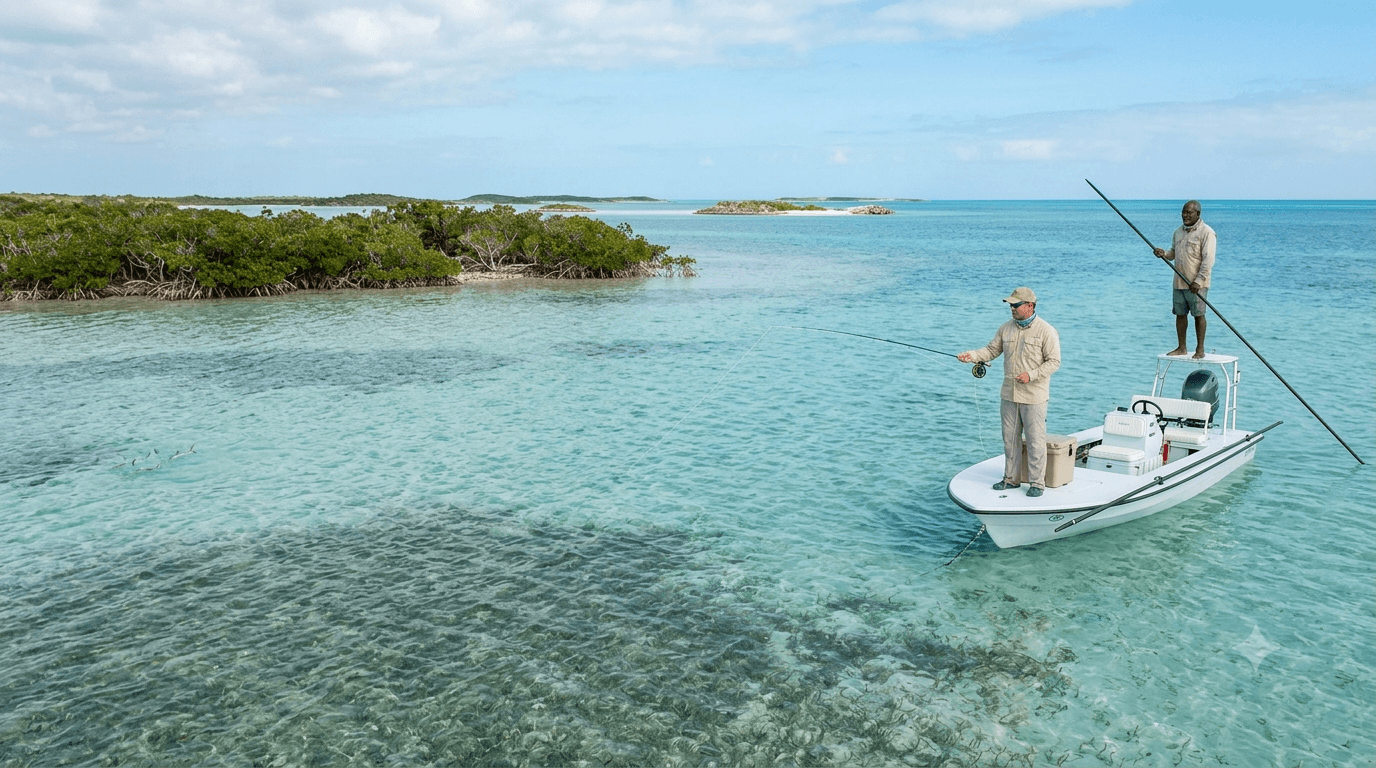
Caicos Banks Interior — The Banks are vast, shallow, and underexplored. Guides who run the interior edges and back-country cuts find tailing fish in conditions that most visiting anglers never access. This is poled-skiff territory. You won't wade it effectively without local knowledge. Depths vary from 8 inches to 4 feet across enormous stretches. When it's right — incoming tide, overcast sky, water in the low 80s — it is as good as flats fishing gets in the Atlantic basin.
Gear Specs
This is a technical fishery. Come set up properly.
Fly Gear — An 8-weight handles 90% of what you'll encounter. On the Banks in wind — and there is always wind — a 9-weight gives you the casting authority to reach tailing fish before they spook. Use a weight-forward floating line. Rio Bonefish or SA Amplitude Bonefish in the 80–85ft head configuration both cast well in the thermal marine air. Leader: 9ft tapered to 12lb fluorocarbon tippet. Go lighter than 10lb and you'll pop off fish in the grass. Go heavier and refusal rates climb in clear water.
Fly Selection — Carry all three of the following:
- Crazy Charlie, tan or white, size 4–6, medium lead eyes. Standard incoming-tide flat in 1–2ft of water.
- Gotcha, pink/pearl, size 4. Early morning and low-light conditions. Fish see it as a fleeing shrimp.
- EP Spawning Shrimp, tan, size 4. Match this when fish are tailing in turtle grass and you're presenting short. It lands softer than a Crazy Charlie and doesn't spook fish in skinny water.
Spinning Gear — Not every angler casting to TCI bonefish is a fly angler, and that's fine. A 7ft medium-light spinning rod rated 8–15lb, paired with a Shimano Stradic 3000 or equivalent, 10lb braid with a 15lb fluorocarbon leader. Small live shrimp under a popping cork or a 1/4oz jig tipped with shrimp both produce. Cut bait is largely wasted on bonefish — they're hunting movement.
Wading Footwear — Non-negotiable. The Caicos Banks has sections of razor-sharp coral and fossilized limestone. Flats boots with hard soles. Simms, Orvis, and Patagonia all make functional options. Don't wade in water shoes.
Reading the Tide
The Turks & Caicos runs a semi-diurnal tide — two highs and two lows per day with moderate variation. Bonefish on the TCI flats move with the tide, not against it.
Fish the incoming tide. Period. As water pushes onto the flats, bonefish follow it looking for crabs, shrimp, and small invertebrates stirred up by the current. The first two hours of the flood are consistently the most productive window — fish are actively moving and feeding, not yet settled into stationary tailing mode or pushed high onto the grass where presentations become difficult.
Dead-low and dead-high slack are slow. At low slack, fish are back in channels and cuts. At high slack, they're buried in the grass and spooked by everything.
Waning gibbous moon phases — like current conditions in late September — historically favor daytime feeding on the flats as overnight illumination decreases and fish shift back to daylight activity cycles. If you're planning a November or December trip, watch the lunar calendar and target the four-day windows around new moon and first quarter. Those incoming tides in the morning are the best combination this fishery offers.
For North Caicos and Bottle Creek, add 15–20 minutes to standard Provo tide predictions. The lagoon fills slightly later than the exposed Banks flats.
What TCI Bonefish Regulations Actually Say
Bonefish are fully protected under TCI fisheries law. Catch and release only — no harvest, no exceptions. The TCI Department of Environment and Coastal Resources (DECR) enforces this strictly. There is no size minimum because there is no legal take.
Barbless hooks are strongly encouraged. On a pressured flat, a fish that's been poorly handled or gut-hooked on a barbed hook is a fish that won't take a fly again that season. Crimp your barbs. Wet your hands before you touch the fish. Keep it in the water. One quick photo, then release headfirst into the current.
Your guide should reinforce this on the water. If they don't, that tells you something about how they operate.
Choosing a Guide
The difference between a productive day on Bottle Creek and a frustrating one usually comes down to the guide — not the weather, not the flies, not your casting.
A good TCI bonefish guide poles quietly, reads fish behavior accurately, calls the shot correctly (distance, direction, and strip speed), and knows which flats to hit on which tide. They're also honest when conditions are wrong — and they'll tell you before you launch, not after three fruitless hours.
Ask these questions before you book:
- Which specific flats do you fish? (If they say 'all of them,' push harder.)
- What's your preferred tide window and why?
- Do you carry fly rods on the boat or do clients bring their own?
- What's your honest assessment of current conditions? (In September, a guide who promises 'great bonefish action right now' is not trustworthy.)
Expect half-day rates in the $400–$600 range and full-day rates in the $700–$950 range for a dedicated flats guide with a purpose-built skiff. Cheaper options exist, but a flats skiff with a good push-pole setup and a bowplate is not optional equipment — it's how you reach fish other anglers can't.
Some guides split their season: offshore and deep-drop from August through October, back on the flats by November. Book accordingly.
When to Go
The best months for TCI bonefishing are November through May. Within that window, December through March is the peak. Water temperatures drop into the 75–80°F range, fish are active on the flats through most of the tidal cycle, and the northeast trade winds produce ideal sight-fishing conditions — enough wind to break the surface glare, not enough to make presentations impossible.
April and May are transitional — fish are still accessible but beginning to group and stage as pre-summer behavior sets in. October is the reopening — water temps are falling from summer highs and fish return to the shallows. Some guides consider late October the sleeper window, with low visitor pressure and fish that haven't seen a fly in four months.
Avoid July, August, and September unless you're booking offshore. Hurricane season is active through November, but experienced TCI operators monitor the NHC and reschedule appropriately. Build trip flexibility into your booking — a rigid 'non-refundable' structure is not how the best guides operate.
If you want one specific window: first quarter moon, incoming morning tide, last week of January or first week of February. The Bottle Creek flats, overcast sky, 78°F water. That's the combination.
Logistics
Getting There — Providenciales International Airport (PLS) is the main entry point. Direct flights from Miami (1hr 45min), New York JFK (~3.5hrs), and Charlotte. Most visiting anglers fly into Provo and either fish the Provo flats directly or arrange a boat transfer or ferry to North Caicos for Bottle Creek.
North Caicos Access — A water taxi runs from Heaving Down Rock on the north end of Provo to Sandy Point on North Caicos. The crossing takes 30–45 minutes. Some guides include the transfer in their rate; confirm this before booking. Accommodations on North Caicos are limited — Bottle Creek Lodge is the primary fishing-focused option and fills early for peak season.
What to Bring — Polarized sunglasses are the most important piece of equipment after your rod. Costa or Smith glass lenses in copper or amber tint cut the flat-water glare better than polycarbonate at midday. Sun protection head-to-foot — long-sleeve technical shirts, buff, and light pants. A casting glove if you have a tendency to cut your hand on the fly line. Nothing bright — bonefish on shallow flats spook from color above the waterline.
Currency and Tipping — The TCI uses the US dollar. Guide tips run 15–20% of the trip rate for a productive day. Pay in cash.