

From the Dock
Early morning trips are moving fast in July—permit and snook are active across the region, but the heat window closes by mid-morning. This article covers nine saltwater and freshwater species across U.S. waters; confirm your guide specializes in your target fish before booking.
It's July 2026. If you're planning a US fly fishing trip right now, the decision tree is simple: flats or rivers. The Southeast flats — Florida Keys, Everglades backcountry, Louisiana marshes — are in peak summer mode. Permit and snook are the primary targets. Tarpon are tapering off after their June run but you'll still find fish. On the river side, the West is fishing well for trout and the Pacific Northwest summer steelhead runs are building. Alaska's king salmon season is winding down but sockeye and silver salmon are ramping up through August. Each system demands a different rod, a different guide, and a different calendar. This guide tells you which is which.
Florida Flats: July Conditions Right Now
July on the Florida flats is not for everyone. Heat builds fast, afternoon thunderstorms roll in daily, and boat pressure on the most accessible flats can kill the fishing by mid-morning. That's not a reason to skip it — it's a reason to hire a guide who starts at first light and knows the backcountry flats that don't get worked until the pressure boats clear out.
Permit are the primary fly target through August. The waning gibbous moon phase we're currently in — 88% illuminated and dropping — is traditionally a strong window for permit. Incoming tide produces the best shots as fish move up onto the flats to feed. Your window is roughly two hours before high water. After that, the fish either hold on structure or push back off the flat.
Snook are present in good numbers but under closed season. FWC's Atlantic coast and Keys snook season is closed June 1 through August 31. That means catch-and-release only right now, and it means fishing for them with barbless hooks. The slot limit is 28–33 inches TL when harvest season reopens in September — know it before you go.
Bonefish are catch-and-release only statewide, no exceptions. Single barbless hooks are strongly recommended. Don't horse a bonefish to the boat in 85-degree water and then hold it up for a three-minute photo session — get it in, get the hook out, and watch it swim.
For tackle: 8-weight floating line for bonefish and permit. Del's Merkin or an EP Crab in tan or olive on a size 2 hook for permit. Crazy Charlie or Gotcha in pink or tan, size 6, for bones. 12-pound fluorocarbon leader, minimum 9 feet. For tarpon, you need a 12-weight — 10 will work on smaller fish under 80 pounds but a 12 gives you the reserve to fight a 120-pound fish in current without killing it. Floating line works fine on shallow-water tarpon; switch to an intermediate running line if fish are stacked in channels deeper than 6 feet.
Western Trout Rivers: What's Fishing in July
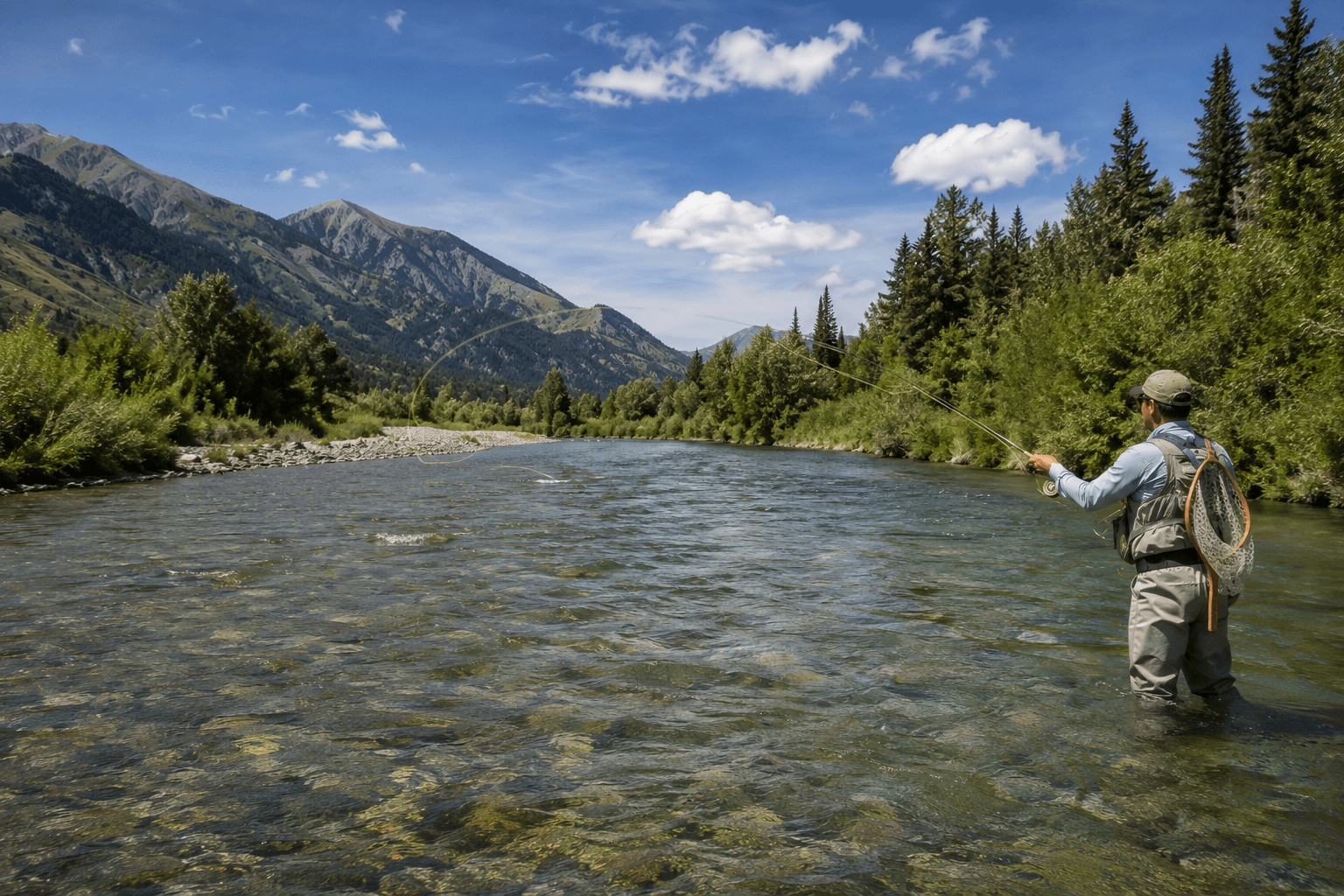
July is prime time for western trout on a dry fly. The salmon fly and golden stonefly hatches have passed on most Montana rivers, but PMDs (pale morning duns), caddis, and terrestrials are carrying the fishing hard through August.
The Madison, Yellowstone, and Missouri rivers in Montana are the most heavily guided rivers in the country. They produce fish, but they also produce traffic. If you want space, look at the Bighorn in southern Montana, the Gallatin above Yellowstone National Park, or the Henry's Fork in Idaho. The Henry's Fork between Harriman State Park and Last Chance is one of the most technically demanding trout fisheries in North America — big rainbows that have seen every fly ever tied, feeding in slow, flat water where a size 18 Sparkle Dun on 6X tippet is a reasonable starting point.
For most western river fishing, a 9-foot 5-weight with a double-taper floating line covers 80% of situations. Carry 5X and 6X fluorocarbon tippet. Elk Hair Caddis in sizes 14 and 16, Parachute Adams 14–18, PMD comparadun in size 16–18, and a hopper pattern (Dave's Hopper or Parachute Hopper, size 8–10) for the afternoon terrestrial bite. The hopper-dropper rig — a size 8 hopper with an 18-inch dropper to a size 16–18 RS2 or Zebra Midge — catches fish all day.
A good western trout guide will row the drift boat, call the casts, and tell you where to mend. They're not there to cast for you. If you haven't mended a line in moving water before, say so up front — a guide who knows this adjusts the float, positions the boat for easier presentations, and saves both of you the frustration.
Alaska: Salmon and Beyond
King salmon season on most Alaska drainages peaks May through late June. If you're reading this in July, you've missed the peak kings on the Kenai and most Southcentral rivers, but sockeye are running strong and silvers (coho) start showing in late July and build through September.
Sockeye on a fly rod is a technical game. They're not eating — they're reacting. A small Coho fly or flesh fly stripped aggressively in front of their faces provokes a reaction strike. 8-weight, sink tip or short integrated head, 12–15 pound fluorocarbon bite tippet. Strip hard and strip fast.
For rainbow trout in Alaska — particularly in the Iliamna region and Bristol Bay drainages — July is excellent. Fish are eating smolt patterns and mouse flies at this point in the season. Big articulated patterns on a 7 or 8-weight with an intermediate line. Swing mouse flies at last light if you want to see what a 24-inch rainbow does to the surface.
Alaska fly fishing almost always means a lodge or fly-in operation. Day trips exist out of Anchorage and Juneau, but the best water is accessed by floatplane. Budget accordingly — a quality fly-in lodge in Bristol Bay runs $5,000–$8,000 per person for a week. A day-trip guide out of Homer or Soldotna for sockeye on the Kenai is $250–$350 per person.
Louisiana Marshes: The Overlooked Redfish Destination
Every competitor guide in this space lists Alaska, Montana, and Florida Keys. Louisiana gets a mention and then nothing useful. Here's the useful version.
The Louisiana marsh system — particularly the Delacroix and Hopedale areas southeast of New Orleans — holds some of the largest redfish in the country on shallow, wadeable flats. These are not the skinny gin-clear flats of the Bahamas. This is turbid water, often stained brown or green, with grass mats, oyster beds, and cuts between marsh islands. You find fish by watching for tailing reds pushing across the grass, or by reading nervous water where pods of fish are moving.
July is hot and buggy. No point pretending otherwise. Guide boats go out early — lines in the water by 6:30am. By 10am the fish are lethargic and the bugs are oppressive. Most guides are back at the dock by noon.
Gear: 8-weight, floating line or slow intermediate. Clouser Minnow in chartreuse and white on a 1/0 hook is the workhorse. Weedless crab patterns work when fish are tailing on the grass. 20-pound fluorocarbon leader — redfish are not leader-shy, and the marsh has oysters that will cut through 12-pound like thread. Guide cost runs $450–$600 for a half-day, two anglers.
How to Choose a US Fly Fishing Guide
This is the section that most fishing content gets completely wrong. They list guides by name and call it done. That doesn't help you pick.
Here's what actually matters:
Species specialization. A guide who fishes tarpon all season can put you on permit, but permit is not their A-game. A trout guide from Colorado who offers 'saltwater fly fishing' on the side has probably put two dozen clients on permit total. Species-specific experience compounds over thousands of days on the water. Ask the guide how many days per year they fish your target species.
Boat type and access. On the Florida flats, a technical poling skiff matters. A guide running a 19-foot flats boat with an elevated poling platform can access 12 inches of water and position the boat quietly. A heavier, cheaper bay boat makes noise, pushes a wake, and spooks fish on skinny water. Ask what hull they're running.
Communication style. Some guides are teachers. Some are hunters — they find fish, position the boat, and expect you to deliver. Neither is wrong, but they're different experiences. If you're a newer fly angler, you want the teacher. If you're flying in with your own rods and 20 years of experience, you want the hunter. Be honest about which you are.
Pricing transparency. Guides on the Florida Keys run $700–$950 for a full day for one or two anglers. Montana drift boat guides run $500–$700. Rates that are significantly below market usually mean a less experienced guide, older equipment, or both. Rates significantly above market should come with a verifiable reputation — consistent customer reviews, tournament results, or media coverage.
Regulations knowledge. Your guide should know every regulation cold before you hit the water. Snook closed season dates, tarpon harvest tag requirements, bonefish barbless hook recommendations — this is their job. A guide who has to look up whether snook are in season isn't operating at the standard you're paying for.
Regional Fly Fishing Quick Reference
Florida Keys / Everglades Target species: Permit, bonefish, tarpon, snook (C&R only until September) Best months: March–June, September–November July conditions: Permit and bonefish fishing now, heat and pressure by 9am. Fish early. Rod: 8-weight (permit/bones), 12-weight (tarpon) Fly: Del's Merkin size 2 (permit), Crazy Charlie size 6 (bones), EP Tarpon Streamer (tarpon)
Louisiana Marsh Target species: Redfish, speckled trout Best months: March–May, September–November July conditions: Productive early morning. Hot and buggy by 9am. Rod: 8-weight floating or slow intermediate Fly: Clouser Minnow chartreuse/white, weedless crab patterns
Montana / Wyoming (trout rivers) Target species: Brown trout, rainbow trout, cutthroat Best months: June–September July conditions: Terrestrial and caddis hatches, dry fly fishing is on. Rod: 9-foot 5-weight, DT floating line Fly: Elk Hair Caddis 14–16, PMD comparadun 16–18, hopper-dropper
Idaho (Henry's Fork / South Fork Snake) Target species: Rainbow trout, brown trout Best months: July–August (Harriman PMD hatch), October (big browns) Rod: 9-foot 5-weight, DT floating line, 6X tippet minimum on Harriman Fly: Sparkle Dun PMD 16–18, Parachute Adams 14–16
Alaska (Bristol Bay / Kenai) Target species: Sockeye salmon, silver salmon, rainbow trout Best months: July–September July conditions: Sockeye running strong. Silvers start building late July. Rod: 8-weight with sink tip or short intermediate running line Fly: Coho Blue, flesh fly, Egg-Sucking Leech
Regulations You Need to Know Before You Cast
Every state has its own rules, and Florida's are among the most complex. Before you book any guided trip in US waters, confirm the following directly with your guide and the relevant state agency.
For Florida specifically, FWC sets these hard rules:
Tarpon require an immediate release unless you hold a $50 Tarpon Harvest Tag, and the minimum harvestable size is 75 inches. Every tarpon under 75 inches goes back immediately — don't hold it in the water for a extended photo session in summer heat. Bonefish are fully catch-and-release, no exceptions, and FWC strongly recommends single barbless hooks. Permit are limited to two fish per day in Florida state Atlantic waters with an 11-inch minimum fork length — no closed season. Snook are in closed season right now through August 31 on the Atlantic coast and Keys — any snook caught in July is catch-and-release only, and the slot limit of 28–33 inches TL applies when the season reopens September 1.
Western states manage trout under their own systems. Montana FWP, Idaho Fish and Game, and Wyoming Game and Fish all have river-specific rules — some streams are catch-and-release only, others have bait bans, and tributary access rules vary. Your guide handles this, but it's worth asking which regulations apply to the specific water you'll be fishing.